Linggo, Oktubre 18, 2015


Introduction

"Blooms Taxonomy"

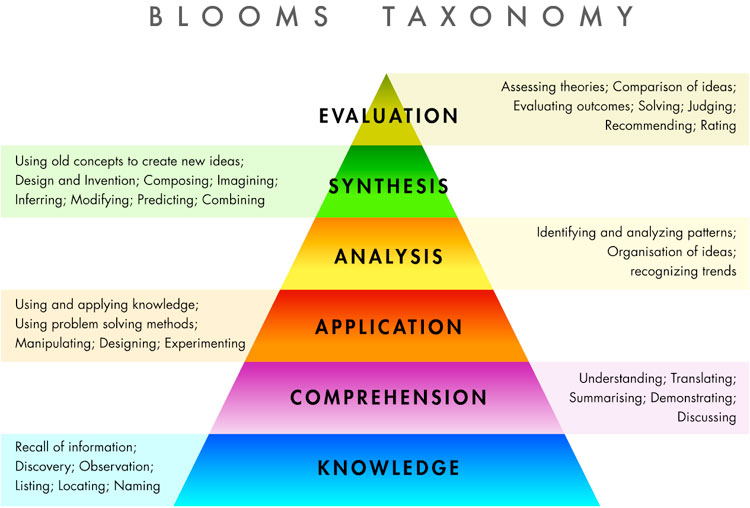
Bloom's Taxonomy was created in 1956 under the leadership of educational psychologist Dr Benjamin Bloom in order to promote higher forms of thinking in education, such as analyzing and evaluating concepts,processes,procedures,and principles, rather than just remembering facts (rote learning).

Bloom's taxonomy was developed to provide a common language for teachers to discuss and exchange learning and assessment methods. Specific learning objectives can be derived from the taxonomy, though it is most commonly used to assess learning on a variety of cognitive levels.

The goal of an educator using Bloom's taxonomy is to encourage higher-order thought in their students by building up from lower-level cognitive skills. Behavioral and cognitive learning objectives are given to highlight how Bloom's taxonomy can be incorporated into larger-scale educational goals or guidelines.
https://community.articulate.com/articles/blooms-taxonomy-elearning-instructional-design

http://www.nwlink.com/~donclark/hrd/bloom.html

http://teaching.uncc.edu/learning-resources/articles-books/best-practice/goals-objectives/writing-objectives

http://www.celt.iastate.edu/teaching-resources/effective-practice/revised-blooms-taxonomy/

https://cft.vanderbilt.edu/guides-sub-pages/blooms-taxonomy/#1956


Benjamin Blooms Taxonomy 


In the 1950's Benjamin Bloom developed his taxonomy of cognitive objectives, Bloom's 
Taxonomy. This categorized and ordered thinking skills and objectives. His taxonomy follows the thinking process. You cannot understand a concept if you do not first remember it, similarly you can not apply knowledge and concepts if you do not understand them. It is a continuum from Lower Order Thinking Skills (LOTS) to Higher Order Thinking Skills (HOTS). Bloom labels each category with a gerund.

Here are the authors’ brief explanations of these main categories in from the appendix of Taxonomy of Educational Objectives :
·         Knowledge - “involves the recall of specifics and universals, the recall of methods and processes, or the recall of a pattern, structure, or setting.”
·         Comprehension - “refers to a type of understanding or apprehension such that the individual knows what is being communicated and can make use of the material or idea being communicated without necessarily relating it to other material or seeing its fullest implications.”
·         Application -  refers to the “use of abstractions in particular and concrete situations.”
·         Analysis - represents the “breakdown of a communication into its constituent elements or parts such that the relative hierarchy of ideas is made clear and/or the relations between ideas expressed are made explicit.”
·         Synthesis -  involves the “putting together of elements and parts so as to form a whole.”
·         Evaluation -  engenders “judgments about the value of material and methods for given purposes.”


Revised Blooms Taxonomy


In the 1990's, a former student of Bloom, Lorin Anderson, revised Bloom's Taxonomy and published this- Bloom's Revised Taxonomy in 2001.Key to this is the use of verbs rather than nouns for each of the categories and a rearrangement of the sequence within the taxonomy. They are arranged below in increasing order, from low to high.
Bloom's Revised Taxonomy Sub Categories
  • Remembering - Recognising, listing, describing, identifying, retrieving, naming, locating, finding
  • Understanding - Interpreting, Summarising, inferring, paraphrasing, classifying, comparing, explaining, exemplifying
  • Applying - Implementing, carrying out, using, executing
  • Analysing - Comparing, organising, deconstructing, Attributing, outlining, finding, structuring,      integrating
  • Evaluating - Checking, hypothesising, critiquing, Experimenting, judging, testing, Detecting, Monitoring
  • Creating - designing, constructing, planning, producing, inventing, devising, making

Each of the categories or taxonomic elements has a number of key verbs associated with it
Lower Order Thinking Skills (LOTS) and Higher Order Thinking Skills (HOTS)
The elements cover many of the activities and objectives but they do not address the new objectives presented by the emergence and integration of Information and Communication Technologies into the classroom and the lives of our students.

Bloom's Revised Taxonomy not only improved the usability of it by using action words, but added a cognitive and knowledge matrix.
While Bloom's original cognitive taxonomy did mention three levels of knowledge or products that could be processed, they were not discussed very much and remained one-dimensional:

          Factual - The basic elements students must know to be acquainted with a discipline or solve problems.
         Conceptual – The interrelationships among the basic elements within a larger structure that enable them to function together. 
         Procedural - How to do something, methods of inquiry, and criteria for using skills, algorithms, techniques, and methods.
In Krathwohl and Anderson's revised version, the authors combine the cognitive processes with the above three levels of knowledge to form a matrix. In addition, they added another level of knowledge - metacognition:

              Metacognitive – Knowledge of cognition in general, as well as awareness and knowledge of one’s own cognition. 


Bloom’s Digital taxonomy (by Andrew Church)


Bloom's digital taxonomy


This tool is a guide to help teachers shift from a teacher-centered learning environment to a 
student-driven one. Students that are given the opportunity to create a project, analyze information, or apply what they learn will have a stronger understanding of the material than just memorizing or summarizing it.
With this information in mind, I re-designed my e-course. It was previously a site with content and daily tasks. Now, it is a site full of challenges and the students will decide what tools they should use to complete each challenge. This will require the students to have an understanding of the differences between the tools and knowledge of how to use the tools to solve a problem.


Creators of this Blog


Mae Patricia Ann R. Abrigo  ( The one who create and develop the blog. She also give some related sites that can help to build and to make this work.  )         
BSEd MAPEH
Adamson University


Angel Sales ( The one who give idea provide some information and formulate the topic )
BSEd MAPEH
Adamson University